
LOCATE A GRAVE

Finding a Grave
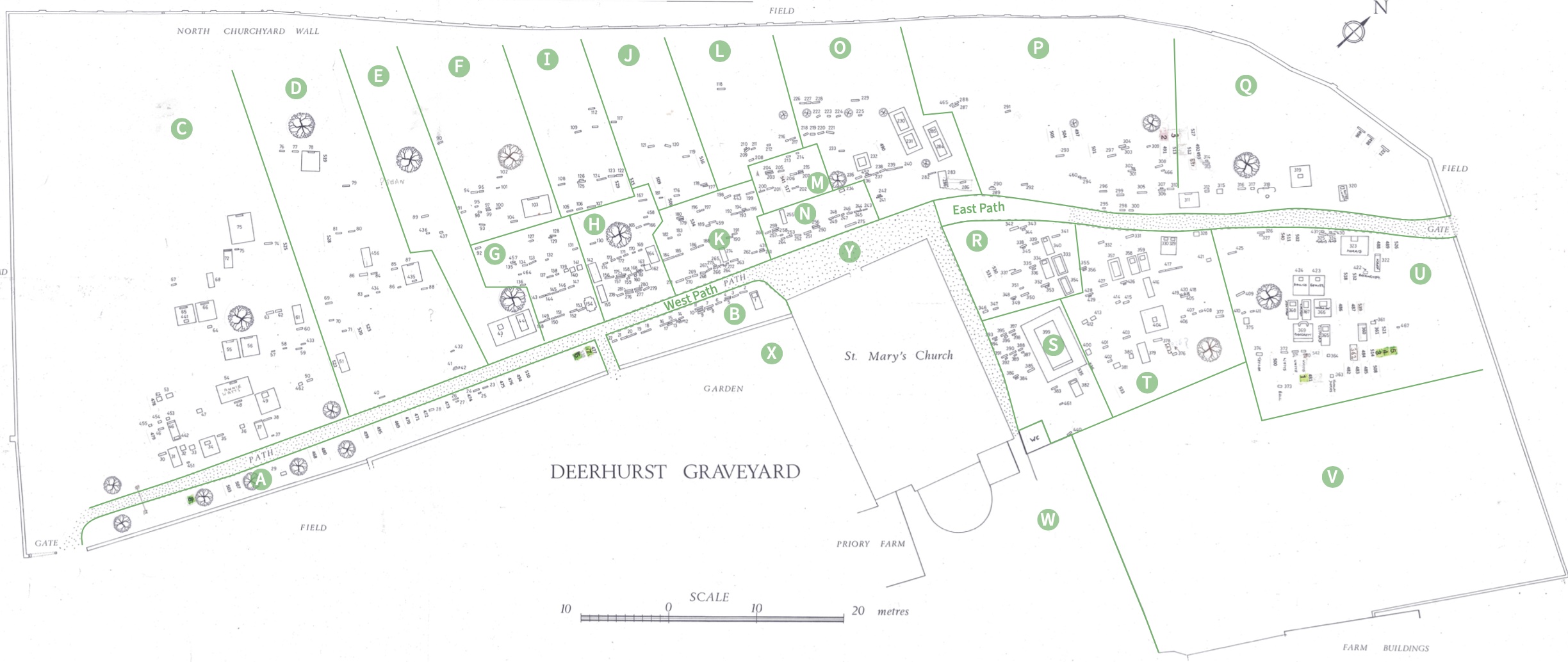
Many people wish to find the graves of their ancestors, so we have compiled a list in a downloadable Excel file: the entry for each name, its date and other details appears in the same row as its grave number and the area in which it is located. There is a map of the whole churchyard to help you locate the area and we have also included detailed maps of each area to help you locate the individual grave. The list will be amended as new information arises.
We have also included a summary history of the churchyard.
Assets to assist in your search
The full-sized scanned pdf format file of the entire plan seen below can be downloaded here.
An XLS spreadsheet of graves can be downloaded here. You can search the list by name and date, and you can then locate each grave by referring to the grave number in the left column and the area in which it is sited shown on the index map above and on the downloadable maps below.

A Brief History of the Churchyard
There has been burial in and around the church at Deerhurst ever since the present church was built in the early 9th century, and probably much earlier. Indeed burial may have begun several centuries before the construction of the church. The churchyard was probably always entered from the south-east, where the gate is now, and by the 18th century there was another entrance as now to the north west onto the present footpath. The five wellingtonias (giant sequoias) are a dominant feature of the churchyard. They were probably planted in the vicar George Butterworth’s time, perhaps in the 1880s. They are still growing in height!
We calculate that over the centuries, there is likely to have been a minimum of 12,000 burials and perhaps as many as 15,000 or even 20,000 burials. Only a small percentage of these were commemorated by surviving monuments. Ten of those have been listed at Grade II buildings (see https://historicengland.org.uk/listing/the-list/ and enter Deerhurst churchyard in the search box). Particularly fine is the group of four tombs commemorating members of the Newman family, which are to be found to the west of the north aisle of the church. Sadly these lost their iron railings during World War II, as did the large Strickland mausoleum to the north of the church.
Notable early burials have been found just outside the west porch and in the farmyard adjacent to the lost apse to the east of the church building. There were also burials within the church for the wealthiest inhabitants: brasses (including the fine Cassey brass) and ledger stones can be seen inside the church, though few if any of them are in their original position. Many of the older gravestones are made of the local blue lias limestone, which is easily cut to allow fine lettering and other carving, but which over time is particularly prone to frost damage; there is little that can realistically be done to preserve such monuments, but fortunately these were surveyed and photographed in the 1980s. Many of the monuments bear inscriptions which are difficult to read unless the sun is casting a raking sidelight; alternatively an evening visit with a torch is often fruitful.
The oldest monuments, from the late 17th and 18th centuries, cluster in a group to be found to the west of the church and extending southwards roughly as far as the gate into the (private) garden. This area may have been reserved for the more prosperous inhabitants, above all the yeomen who formed the backbone of Deerhurst’s agricultural economy. Poorer inhabitants were probably interred elsewhere in the graveyard, perhaps initially marked by a simple wooden memorial.
The two oldest surviving gravestones are two small headstones with west-facing inscriptions about 17.5 m west of the south aisle. One commemorates Thomas Greenway who died on 26 March 1671, and the other, only 1.40 m to the south, records Elizabeth, the daughter of Thomas Carpenter and Jone his wife with a date of death on 8 April 1671. The two families were related and the two monuments may have been produced by the same mason at the same time.
From the early 19th century onwards the remainder of the churchyard began to be filled with monuments. At the northern end of the churchyard, not far from the northern gate, a striking monument is a ring-headed cross with interlace ornament; this marks the burial of George Butterworth (d. 16 September 1909), the vicar from 1856 to 1893, in whose time the major restoration of the church took place in 1861–2. Among gravestones of the last 50 years, the monument (to the south-east of the Butterworth cross) to Martin Edward Tilley (d. 1990) and Joyce Mary Tilley (d. 1996) is most attractive with beautiful lettering and an apt Shakespearean quotation.
There are a number of graves which commemorate those who died in various wars. The earliest known refers to William Dipper (d. 1900), who is commemorated on the gravestone of his sister Emma. William was one of the many British servicemen who succumbed to typhoid at Bloemfontein during the Second Boer War; a contemporary newspaper account reports that he had been lightly wounded nine times!
There are two Commonwealth War graves from World War One. The first is readily visible to the west of the path leading to the church and commemorates Private Lewis Cox (d. 1917) of the Royal Army Medical Corps; the second, commemorating Private George Chalk (d. 1919) of the Royal Army Service Corps is less obviously sited, but lies some 15 m south-west of Lewis Cox’s stone. Four more victims of World War One, buried elsewhere, are recorded on monuments erected to other family members. The main parish war memorial is at Apperley.